Shri Janubai Temple,
Shri Janubai Temple, Ambade — A Divine Heritage of the Maratha Era
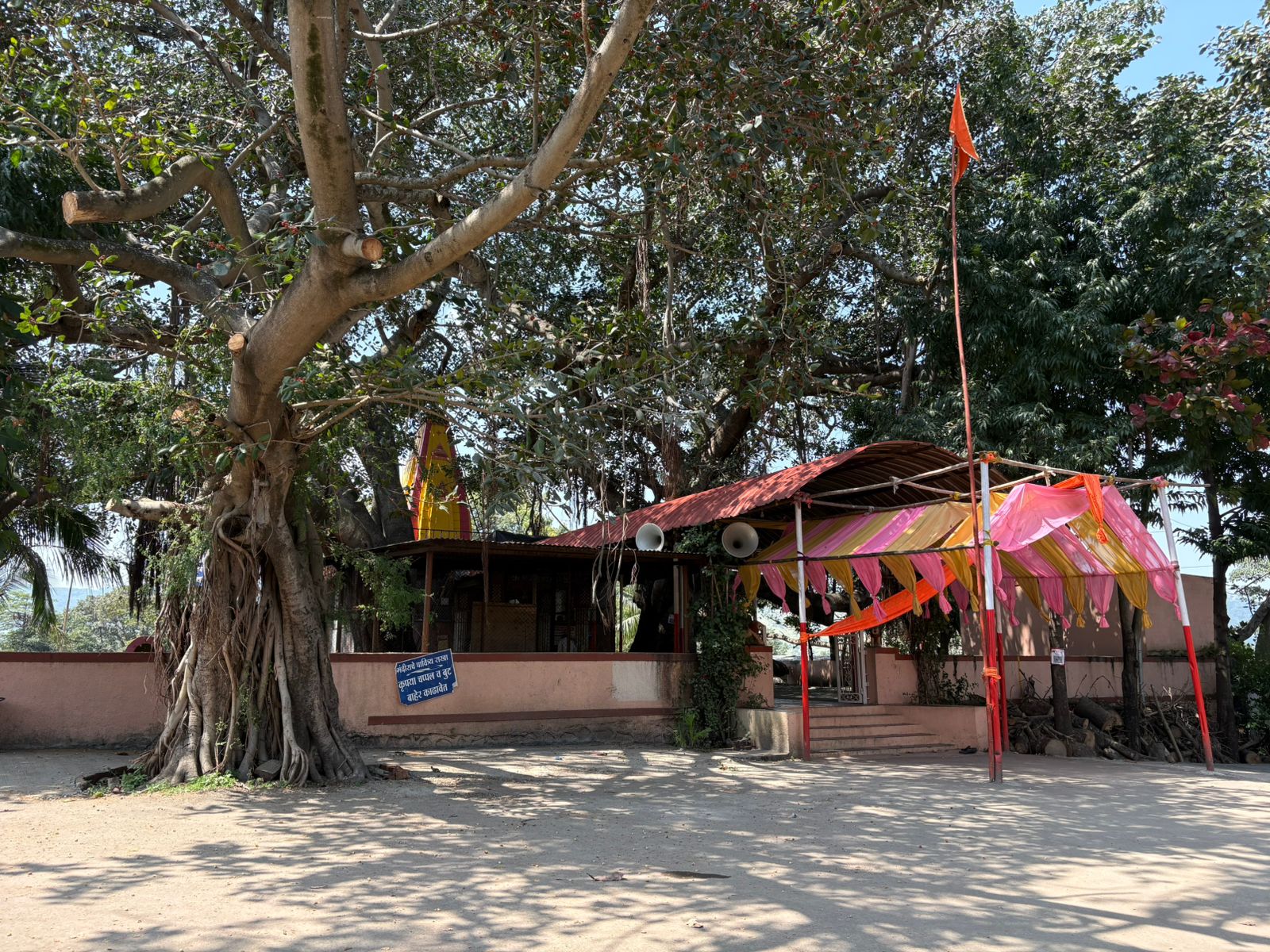
Shri Janubai Temple at Ambade is an ancient and awakened temple from the Chhattrapati Shivaji Maharaj era, regarded as the Gramdaivat (Village Deity) of Ambade village and the Kuldevi (Family Goddess) of the Khopade family, which traces its heritage back to the Maratha period.
The temple has been officially recognized by the Maharashtra State Tourism Department as a Category “C” pilgrimage site.
Emotional & Devotional
A Temple Rebuilt with Faith and Devotion
The People of Ambade Revived Their Divine Heritage through Collective Effort
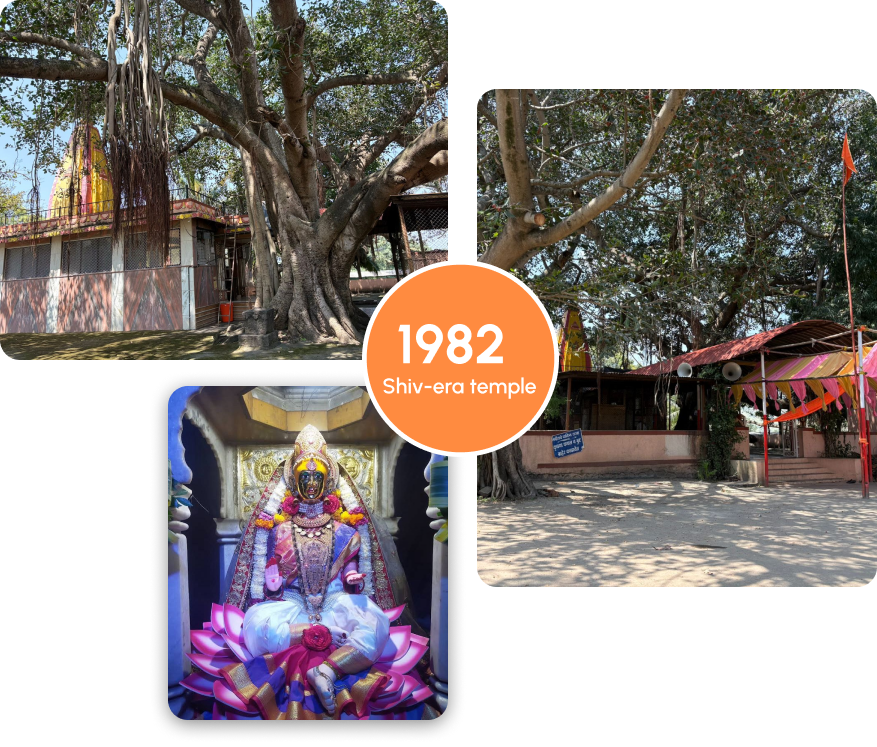
The original Shiv-era temple had fallen into ruin over time. In 1982, the local mill workers and villagers came together and rebuilt it using stones, bricks, and tin sheets.
In 2004, Shri Pradeep Dada Khopade presented the idea of a complete temple renovation to the villagers. With their collective support, the temple reconstruction began.
At that time, the temple was accessible only through a narrow footpath (Panand Road)—even two-wheelers couldn’t reach the site. Through the initiative of Pradeep Dada Khopade, and with the help of local farmers and villagers, a motorable road was built from the village school up to the temple, and construction work began in full swing.
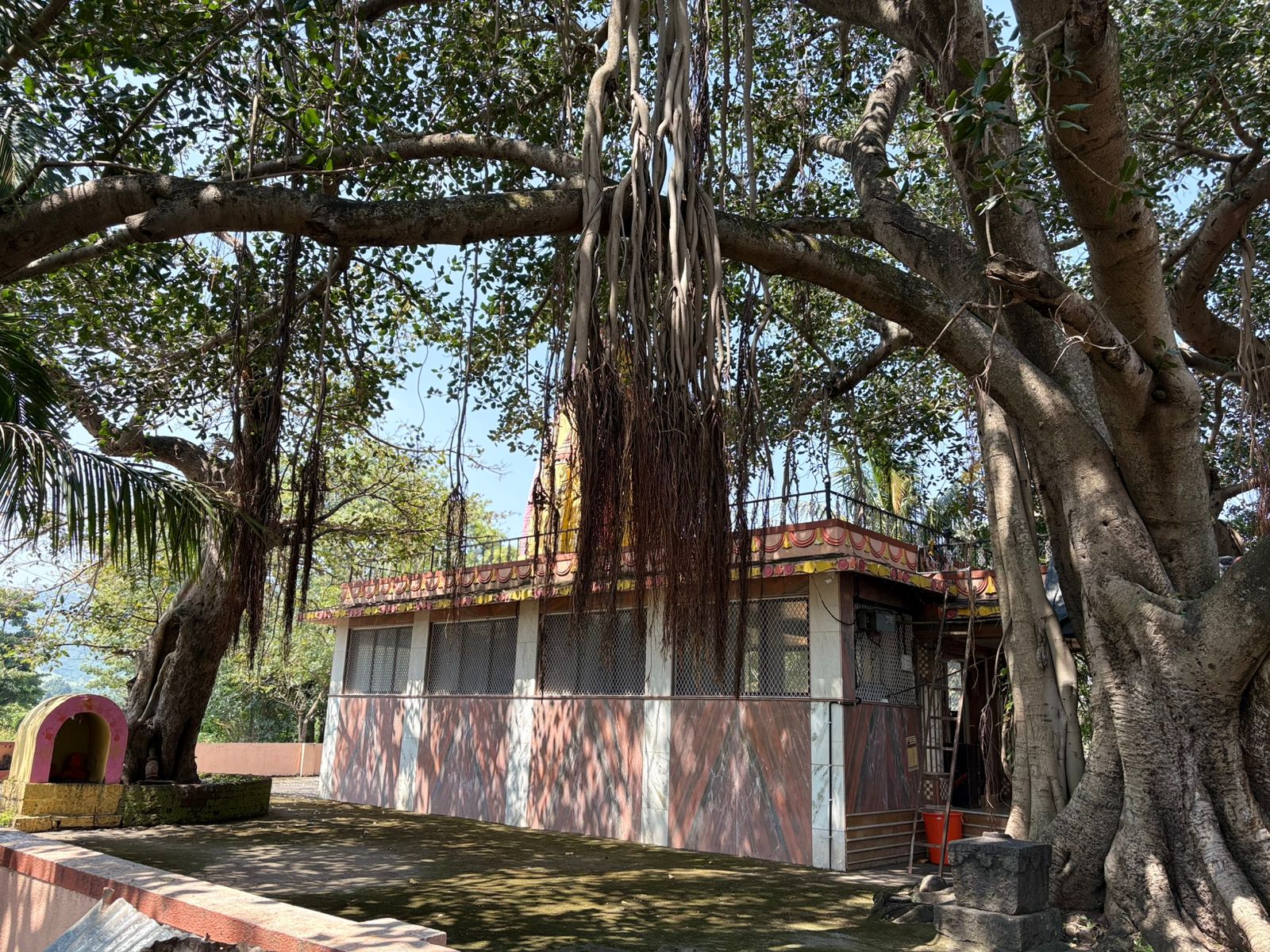
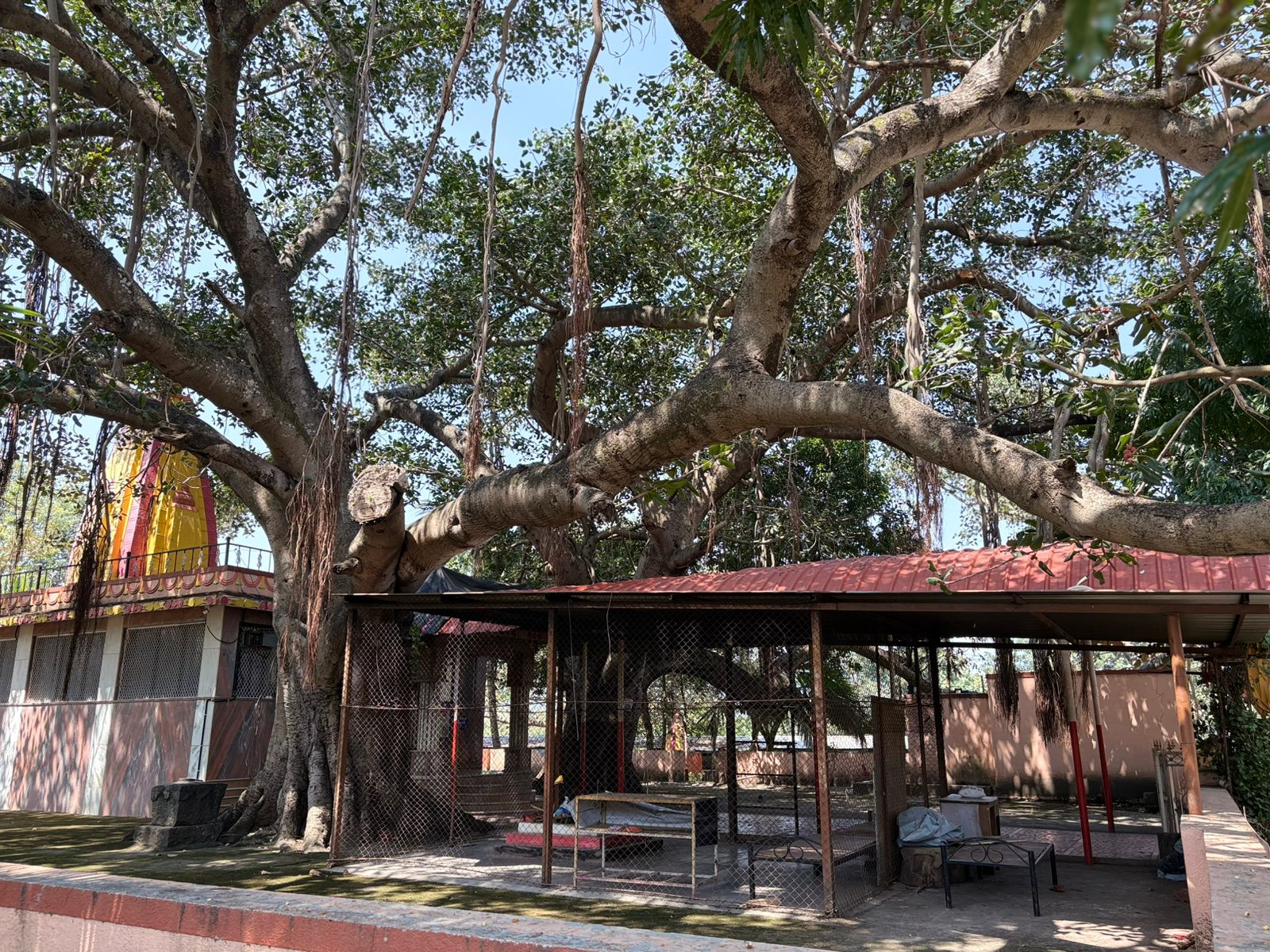
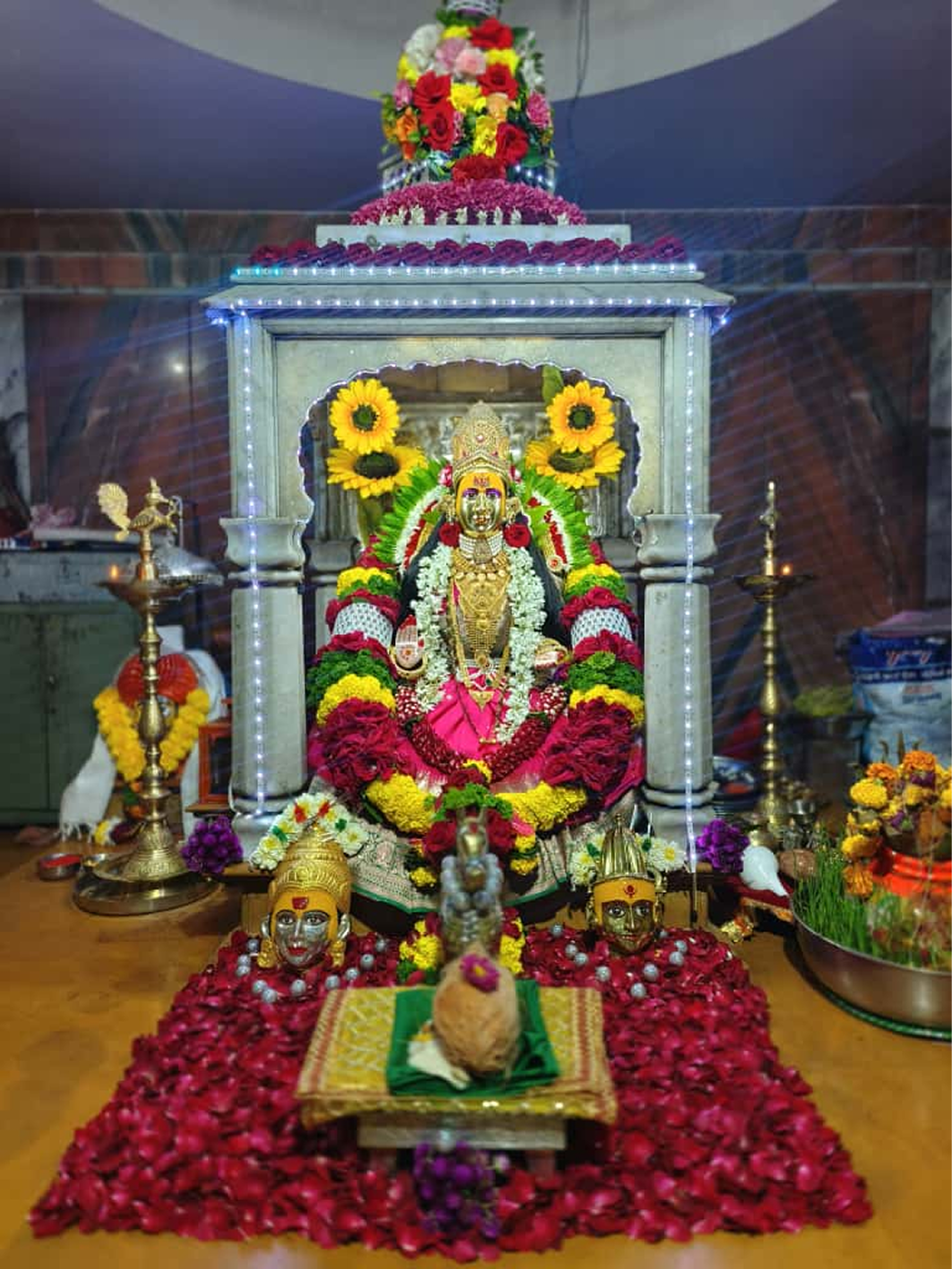
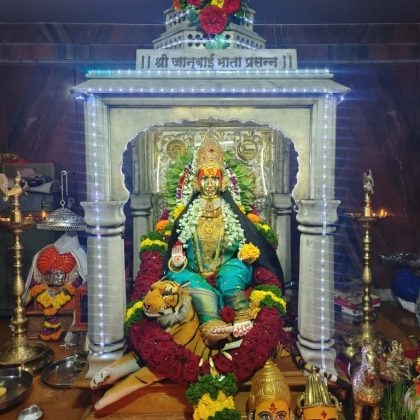
The temple construction that began in 2004 was completed in 2005, and on June 1, 2005, a grand Kalasharohan (Consecration Ceremony) was performed at the hands of Sadguru Narayan Maharaj. The temple is entirely built of marble, and beside it stand two ancient, majestic banyan trees. The surroundings are naturally beautiful and very peaceful.
In 2004, Shri Pradeep Dada Khopade presented the idea of a complete temple renovation to the villagers. With their collective support, the temple reconstruction began.
At that time, the temple was accessible only through a narrow footpath (Panand Road)—even two-wheelers couldn’t reach the site. Through the initiative of Pradeep Dada Khopade, and with the help of local farmers and villagers, a motorable road was built from the village school up to the temple, and construction work began in full swing.
The temple construction that began in 2004 was completed in 2005, and on June 1, 2005, a grand Kalasharohan (Consecration Ceremony) was performed at the hands of Sadguru Narayan Maharaj. The temple is entirely built of marble, and beside it stand two ancient, majestic banyan trees. The surroundings are naturally beautiful and very peaceful.
Traditional & Informative
Deity and Temple Structure
Shri Janubai Mata — The Four-Armed Goddess of Protection and Power
The idol of Shri Janubai Mata is carved from black stone and depicts the Goddess in a four-armed (Chaturbhuja) form. In three hands, she holds divine weapons — the Gada (mace), Trishul (trident), and Khagra (sword) — while the fourth hand is extended in blessing posture, forever protecting her devotees.
She is believed to be the elder sister of Lord Khandoba.
Nearby shrines include temples dedicated to Sati Aai Mata, Kalbhairav, and other deities.
Daily ritual worship and lighting of lamps are performed. A permanent ghee lamp burns continuously in the sanctum. On the right side of the temple is a Yajna Shala (sacrificial hall) with a Homkunda (fire altar) that remains lit 24 hours a day, 12 months a year.
Daily ritual worship and lighting of lamps are performed. A permanent ghee lamp burns continuously in the sanctum. On the right side of the temple is a Yajna Shala (sacrificial hall) with a Homkunda (fire altar) that remains lit 24 hours a day, 12 months a year.
Traditional & Informative
Festivals and Celebrations
Shri Janubai Mata — The Four-Armed Goddess of Protection and Power
The annual fair (Yatra) is held on the Panchami after Paush Purnima. On this day, the Goddess’s procession (Chhabina) is carried out. The Goddess’s vehicle is a horse, followed by a palanquin, and the event is celebrated with traditional Lezim, Dhol-Tasha, and Shehnai-Choughada music.
On every Purnima (Full Moon day), a Maha Abhishek (Grand Holy Bath) is performed, followed by a Yagna (Havan), and Mahaprasad is distributed among devotees.
On every Ashtami (eighth lunar day), the reading of Devi Saptashati is conducted, and Ashtami Pooja is performed in the temple.
The temple’s anniversary is celebrated on June 1 each year, where villagers and devotees gather to celebrate with great enthusiasm.
On every Ashtami (eighth lunar day), the reading of Devi Saptashati is conducted, and Ashtami Pooja is performed in the temple.
The temple’s anniversary is celebrated on June 1 each year, where villagers and devotees gather to celebrate with great enthusiasm.
Traditional & Informative
Navratri Utsav (Festival)
Shri Janubai Mata — The Four-Armed Goddess of Protection and Power
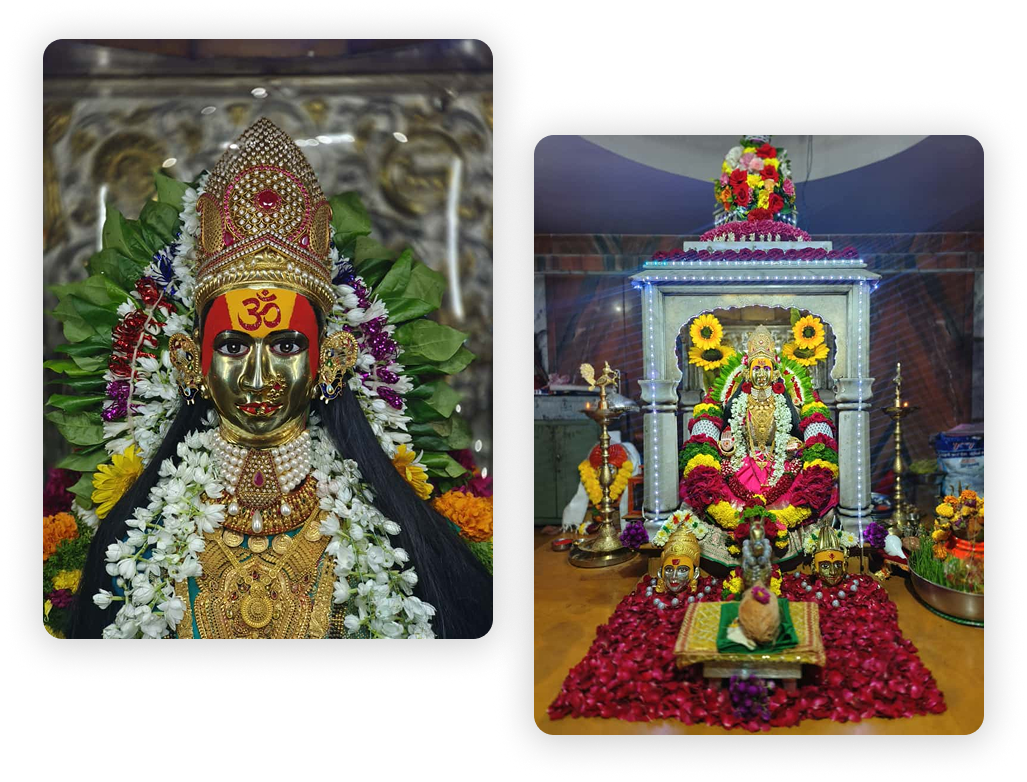
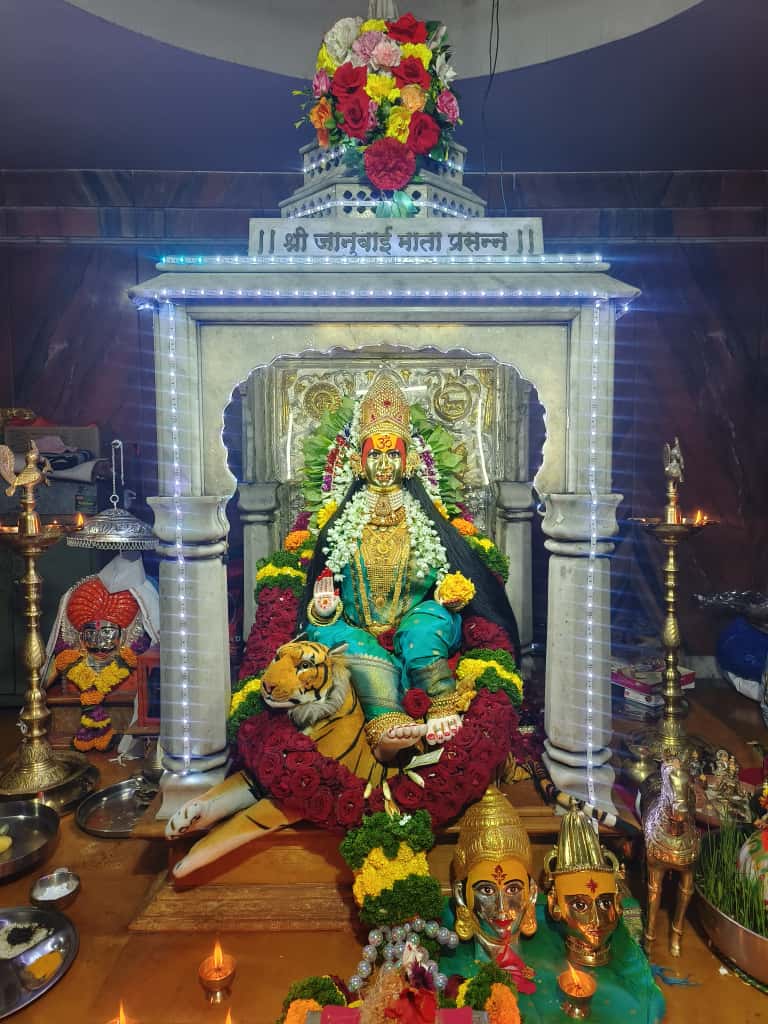
The Sharadiya Navratri Festival is celebrated annually with immense devotion and grandeur. During this time, a Shatchandi Path (recitation of sacred hymns) and Havan are performed. Devotees from across the district, as well as villagers residing in other places, come for darshan without fail.
The temple is beautifully decorated with lights, floral arrangements, and mandaps. • Morning Aarti begins at 5:30 AM. • From 8 AM to 2 PM, Saptashati Path and Havan are conducted. • From 5 PM to 7 PM, Haripath (devotional singing) takes place. • From 7 PM to 9 PM, Bhajans are held, followed by the Maha Aarti. • The night concludes with Devi Jagaran (night-long vigil). • At dawn, the Goddess’s attire is changed, followed by the morning Aarti.
Throughout Navratri, the Shri Janubai Mata Trust provides free hot khichdi (fasting meal), drinking water, and tea for all devotees during the day. The Chaitra Navratri festival is celebrated with equal devotion and enthusiasm. On Dussehra, the Devi’s Palanquin is taken out for Simollanghan (ritual boundary crossing), and after returning to the temple in the village, an Aarti and community gathering take place.
The Kojagiri Purnima celebration includes a Maha Abhishek, followed by Aarti, Mahaprasad, and a community feast (Vanbhojan), which is enjoyed by all villagers and devotees with great joy
The temple is beautifully decorated with lights, floral arrangements, and mandaps. • Morning Aarti begins at 5:30 AM. • From 8 AM to 2 PM, Saptashati Path and Havan are conducted. • From 5 PM to 7 PM, Haripath (devotional singing) takes place. • From 7 PM to 9 PM, Bhajans are held, followed by the Maha Aarti. • The night concludes with Devi Jagaran (night-long vigil). • At dawn, the Goddess’s attire is changed, followed by the morning Aarti.
Throughout Navratri, the Shri Janubai Mata Trust provides free hot khichdi (fasting meal), drinking water, and tea for all devotees during the day. The Chaitra Navratri festival is celebrated with equal devotion and enthusiasm. On Dussehra, the Devi’s Palanquin is taken out for Simollanghan (ritual boundary crossing), and after returning to the temple in the village, an Aarti and community gathering take place.
The Kojagiri Purnima celebration includes a Maha Abhishek, followed by Aarti, Mahaprasad, and a community feast (Vanbhojan), which is enjoyed by all villagers and devotees with great joy
Traditional & Informative
Shri Janubai Mata Marriage Hall (Mangal Karyalay)
Another noble project envisioned by Pradeep Sheth Khopade is the Shri Janubai Mata Marriage Hall, built to the right of the temple.
Its purpose is to enable poor and underprivileged families from nearby villages to conduct their children’s weddings at minimal or no cost, ensuring the beginning of a happy married life.
Its purpose is to enable poor and underprivileged families from nearby villages to conduct their children’s weddings at minimal or no cost, ensuring the beginning of a happy married life.
Every year, 30 to 40 weddings are held at this marriage hall, serving as a blessing to countless families